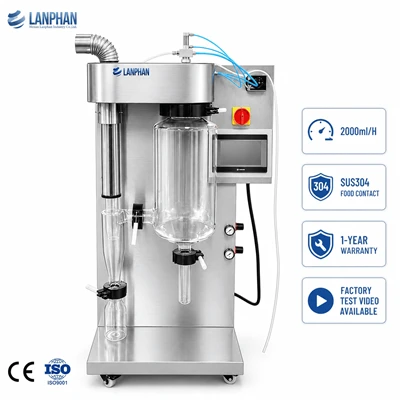
Spray Dryer for Liquid-to-Powder Processing
Spray drying converts liquid feed into powder through controlled atomization and hot-air drying. Process conditions affect particle size, residual moisture, thermal exposure, and product yield.
Lanphan spray dryers are used in laboratory research, pilot-scale process development, and industrial production. Typical users include chemical manufacturers, process engineers, plant managers, and equipment procurement teams.
-
![Dairy Spray Dryer]() Dairy Spray DryerThe Dairy Spray Dryer is a laboratory spray drying system with 1.5–2 L/h water evaporation capacity, using peristaltic feeding and nozzle atomization for dairy R&D, formulation trials, and...
-
![Two Fluid Nozzle Spray Dryer]() Two Fluid Nozzle Spray DryerTwo Fluid Nozzle Spray Dryer uses compressed air or gas to atomize liquid feed into fine droplets before hot-air drying.
-
![Industrial Spray Drying Machine]() Industrial Spray Drying MachineIndustrial Spray Drying Machine is designed to convert pumpable liquid feeds into free-flowing powder through controlled atomization and rapid moisture removal. It suits process-scale drying where...
-
![Centrifugal Spray Dryer]() Centrifugal Spray DryerThe Centrifugal Spray Dryer is designed to convert pumpable liquid materials, including solutions, emulsions and suspensions, into dry powder through high-speed centrifugal atomization and hot-air...
-
![Pilot Scale Spray Dryer]() Pilot Scale Spray DryerPilot Scale Spray Dryer is a 1.5–2 L/h water-evaporation system for pilot-scale drying of solutions, suspensions, and paste-like feeds. It uses spray atomization and hot-air contact for process...
-
![Small Spray Dryer]() Small Spray DryerSmall Spray Dryer is a compact laboratory-scale drying system for converting liquid solutions, emulsions, and suspensions into dry powder through controlled atomization and hot-air drying. It is...


Engineering Guidelines for System Selection
Evaporation Load Calculation:
Calculate hourly water removal requirements based on initial feed solids percentage and total feed flow rate.
Thermal Sensitivity Assessment:
Biological substances and heat-sensitive botanical extracts require lower inlet temperatures and controlled residence times within the drying chamber.
Atomization Selection:
Centrifugal atomizers are suitable for higher feed rates and general powder production. Nozzle atomizers offer tighter control of droplet and particle size for applications requiring narrower distributions.
Technical Specifications and Model
|
Model Series |
Evaporation Capacity (kg/h) |
Heating Source Options |
Atomization Type |
Primary Application |
|
LP-5 |
3 - 5 |
Electric / Steam |
High-Speed Centrifugal |
Laboratory Research, Formulation Testing |
|
LP-25 |
20 - 25 |
Electric / Steam / Gas |
Centrifugal / Nozzle |
Pilot Scale, Botanical Extracts |
|
LP-50 |
50 - 60 |
Steam / Natural Gas |
Centrifugal Atomizer |
Food Ingredients, Fine Chemicals |
|
LP-100+ |
100 - 300+ |
Steam / Gas / Thermal Oil |
Multi-Nozzle / Centrifugal |
Industrial Production, Advanced Materials |
Sector-Specific Applications
Pharmaceutical Processing:
Engineered for active pharmaceutical ingredients and excipients. Features clean-in-place (CIP) compatibility, sanitary weld standards, and cGMP alignment.
Food and Beverage Production:
Applied in the dehydration of dairy powders, nutritional ingredients, and flavor emulsions under controlled thermal exposure.
Chemical and Advanced Materials:
Utilized for synthesizing catalyst precursors, ceramic powders, and polymer emulsions where particle morphology affects downstream processing.

How Does a Spray Dryer Work?
Feed Atomization:
Liquid feed is pumped into an atomizer (centrifugal wheel or pressure nozzle) located at the top of the drying chamber, transforming the bulk liquid into a fine mist of droplets to maximize surface area.
Particle Formation and Separation:
As moisture evaporates, solid particles form and drop toward the bottom of the chamber, while exhaust air carries fine particles into a cyclone separator for recovery.
Hot Air Contact:
Heated air enters the drying chamber through an air distributor, immediately mixing with the atomized droplets to facilitate rapid moisture evaporation.
Powder Collection:
Dried powder is discharged from the main chamber and cyclone collection points into sealed containers.
Feed Material & Process Requirements
Solids Content and Viscosity:
Higher feed concentration reduces the thermal energy required for evaporation, provided the fluid remains pumpable and atomizable.
Thermal Threshold:
Materials with low glass transition temperatures or heat sensitivity require specific inlet and outlet temperature limits to prevent product degradation or wall sticking.
Solvent Type:
Aqueous solutions utilize standard open-loop heating, while flammable organic solvents require inert gas closed-loop systems equipped with solvent condensation units.

Factory Acceptance Testing (FAT): Each system is checked before shipment for blower operation, heating output, control cabinet wiring, and programmed control logic.
Material Traceability: Material certificates are provided for stainless steel pressure vessels and key structural components to support material verification and production records.
Documentation Verification: Operating manuals, electrical wiring diagrams, component lists, and relevant inspection records are supplied with the equipment for installation, commissioning, and maintenance.
Customized Spray Dryer Configuration
Material Selection: Product-contact parts can be specified in SUS304, SUS316L, or other corrosion-resistant materials according to feed composition and process requirements.
Drying Capacity and Chamber Configuration: Feed capacity, drying chamber size, atomizer type, nozzle specification, and powder collection configuration can be adjusted to match throughput and product characteristics.
Dust Collection and Exhaust Treatment: Bag filters, cyclone separators, or wet scrubbers can be integrated into the exhaust system for fine powder recovery and process-specific emission requirements.
Automation and Control: PLC and touchscreen HMI systems can be configured for temperature, feed rate, airflow, and pressure control, with options for data logging, alarms, and automated cleaning functions.
FAQ
Q: What replacement wear parts should be kept in stock?
A: Keep atomizing discs, nozzle tips, air filters, thermocouples, and shaft seals on hand. Specific part numbers and replacement intervals are detailed in the manual.
Q: What utility infrastructure is required prior to installation?
A: Prepare the required electrical load, compressed air lines for pneumatic controls, an exterior exhaust duct route, and a dedicated water source if utilizing cleaning options. Utility layout drawings are provided upon order confirmation.
Q: Are on-site installation and operator training available?
A: Technical personnel are available for on-site mechanical assembly supervision, system commissioning, and staff training. Remote guidance options are also supported.
Q: What is the standard production and delivery lead time?
A: Lead times depend on evaporation capacity, heating source specifications, and custom engineering requirements. Production schedules are confirmed during technical review.
Q: How are heating sources configured when natural gas or steam is unavailable?
A: Systems can utilize high-capacity electric heating banks or thermal oil heat exchanger loops when gas or steam lines are restricted, subject to local power limits.
Q: What compliance documentation is included with shipments?
A: Shipments include mill test reports, electrical schematics, operating manuals, and inspection check sheets. Additional regional third-party certifications can be arranged upon request.
Q: Can the control system integrate with plant automation networks?
A: Control panels utilize programmable logic controllers with standard communication protocols for integration into plant supervisory systems and data logging networks.
Q: What safety interlocks are used for volatile or combustible feeds?
A: Systems processing flammable solvents or combustible powders include oxygen monitors, explosion-relief panels, pressure differential sensors, and automated inert gas purging.
As one of the most professional spray dryer suppliers in China, we have world-leading production equipment and strong manufacturing capabilities. Please rest assured to wholesale advanced spray dryer for sale here from our factory. For price consultation, contact us.